
 Polski (PL)
  Italiano (IT)
  Deutsch (DE)
  Hrvatski (HR)
  English (EN)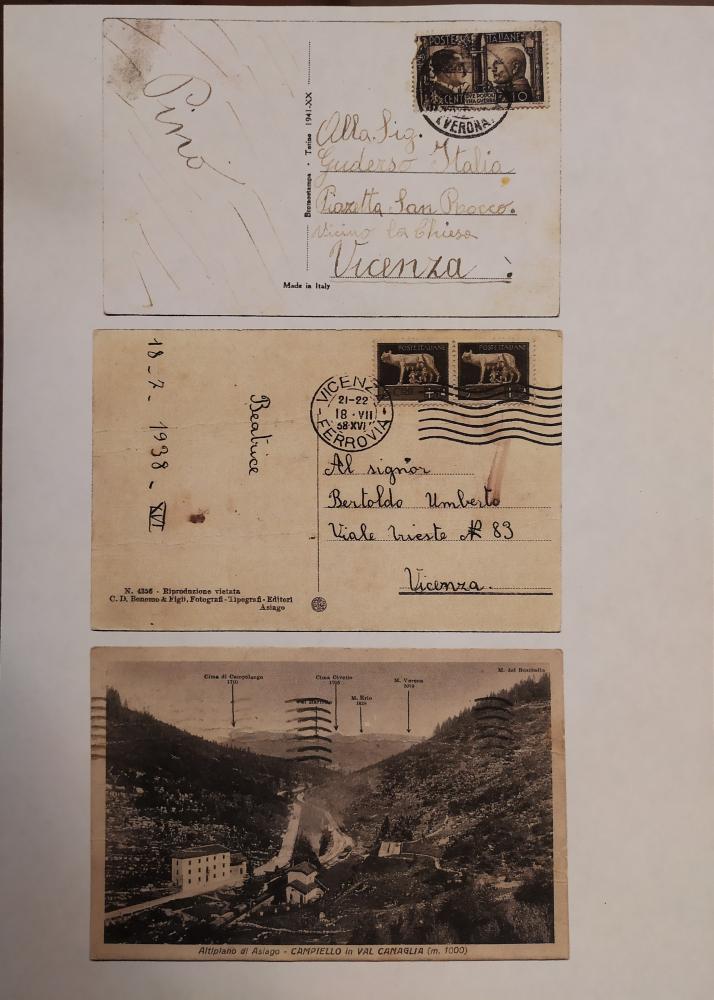

This image depicts two postcards from the fascist era:
the first is reproduced only on the rear facade, since the other facade represents the Holy Family and the words Merry Christmas. On the back shown here we see a stamp that belongs to the first commemorative series of the Second World War. In particular, the series entitled "Italian-German Brotherhood of Arms celebrates the Pact of Steel between fascist Italy and Nazi Germany. The stamp we see is the lowest value in the series, it was issued in April 1941, it is worth 10 cents and is brown in color. It depicts the austere profiles of Hitler and Mussolini, facing each other, framed by Nazi and Fascist symbols (eagle, swastika, fasces).
There were not many values of the Italian Post Office that represented the face of Mussolini.
In addition, on this stamp and on the whole series there is no symbol of the monarchy, the shield of the Savoy flanked by the fasces, which instead appeared in all Italian values prior to and following the Fascist era.
We see this symbol, in fact, in the stamps on the back of the second postcard, sent on August 17, 1938 from the Asiago plateau. In this case, the image reproduced on the stamp is the Capitoline wolf, an imperial series, much loved by Mussolini and used by him for propaganda purposes, to present himself as the founder of the new Rome.
The most interesting facade of this document, however, is the front one: a black and white photograph of the Canaglia valley, just before the village of Tresché Conca, at the Campiello station. A train is passing along the railway, now transformed into a pedestrian and cycle track. On the left you can see a building still present which today houses the Trattoria ai Granatieri. The postcard, dated 17 August 1938, shows the bare mountain slopes, with few trees: nature still bears the marks of the war, which has devastated men, woods, villages and mountains. Not even storm Vaia managed to make such a big disaster!
Questa immagine ritrae due cartoline di epoca fascista:
la prima è riprodotta solo nella facciata posteriore, poiché l’altra facciata rappresenta la Sacra famiglia e la scritta Buon Natale. Nel retro qui riportato notiamo un francobollo che appartiene alla prima serie commemorativa della Seconda Guerra Mondiale. In particolare, la serie intitolata “Fratellanza d’armi italo-tedesca celebra il Patto d’Acciaio fra l’Italia fascista e la Germania nazista. Il francobollo che vediamo è il valore più basso della serie, è stato emesso nell’aprile del 1941, vale 10 centesimi ed è di colore bruno. Raffigura i profili austeri di Hitler e Mussolini, l’uno rivolto verso l’altro, incorniciati dai simboli nazisti e fascisti (aquila, croce uncinata, fascio littorio).
Non furono molti i valori delle Poste Italiane che rappresentavano il volto di Mussolini.
Inoltre, su questo francobollo e su tutta la serie non è presente il simbolo della monarchia, lo scudo dei Savoia affiancato dai fasci, che invece figurava in tutti i valori italiani precedenti e seguenti nell’epoca fascista.
Vediamo questo simbolo, infatti, nei francobolli sul retro della seconda cartolina, spedita il 17 agosto 1938 dall’Altopiano di Asiago. In questo caso l’immagine riprodotta nel francobollo è la lupa capitolina, serie imperiale, molto amata da Mussolini e da lui usata a scopo propagandistico, per presentarsi come il fondatore della nuova Roma.
La facciata più interessante di questo documento, però, è quella anteriore: una fotografia in bianco e nero della val Canaglia, poco prima del paese di Tresché Conca, all’altezza della Stazione di Campiello. Lungo la ferrovia, oggi trasformata in pista ciclo-pedonale, sta transitando un treno. Si vede sulla sinistra un edificio ancora presente che oggi ospita la Trattoria ai Granatieri. La cartolina, datata 17 agosto 1938, mostra i versanti della montagna brulli, con pochi alberi: la natura porta ancora i segni della guerra, che ha devastato uomini, boschi, paesi e montagne. Neanche la tempesta Vaia è riuscita a fare un disastro così grande!
